
Coping Caps Rocking Loose
Caps fastened on one side only lift at the joints, letting rain run down inside the parapet wall. Joint covers and fresh sealant close it.
Greenup County · Riverfront
As a Russell commercial roofing contractor, we install and replace roofs on riverfront buildings, with extra time on edges, corners, and coping that take wind off the Ohio.
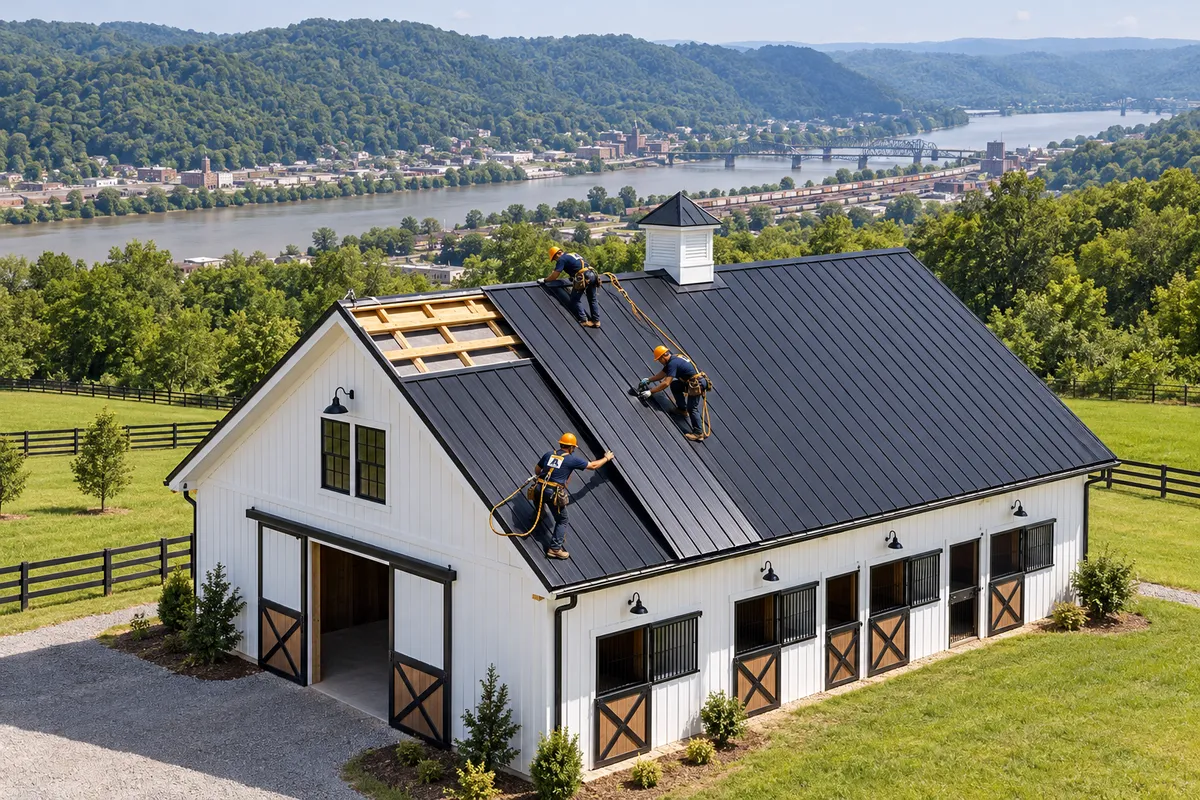
Riverfront Roofs

Edges come first for a Russell commercial roofing contractor. Russell sits along open Ohio River frontage, and wind crossing the water reaches roof edges, corners, and parapet caps first. On a Russell roof, the perimeter takes more work than the field.
Edge metal and perimeter fastening get extra time on every job here, because a loose cleat at the edge is where a membrane starts to peel. The field sheet matters too, but the edge is where a Russell roof is won or lost.
Roof Conditions
Wind damage starts small at the edge and works inward. These are the signs we look for first.
Caps fastened on one side only lift at the joints, letting rain run down inside the parapet wall. Joint covers and fresh sealant close it.
Corner zones carry the most uplift, and a sheet fastened at field spacing billows there first. Closer fastening at the corners fixes it.
Rotted wood nailers under the edge metal let fasteners back out until the drip edge flaps in a storm. New nailers come first.
Repeated flexing at the perimeter works seam edges open on older sheets, often a few feet in from the wall. A new lap or cover strip closes them.
Rake trim on metal buildings takes the gusts first, and loose screws there let panel ends rattle. Fresh screws and closures hold them.
Inside stains along an exterior wall usually trace back up to the coping or wall flashing above them. Sealing the coping joints stops it.
Benefits
A Russell reroof with the perimeter done right holds its edges through the windy months.
New nailers, continuous cleats, and coping fastened on both sides keep the perimeter from lifting in a river gust.
Tighter fastening or full adhesion at the corners holds the sheet where wind pulls hardest.
Sealed coping joints stop water from running down the inside of the parapet and staining the wall.
Wet boards found at the edge are replaced, so the new roof starts on dry insulation.
Gutters and downspouts fastened through new straps stay on the building when wind and ice load them at the same time.
Our Services
Russell roofs range from riverfront storefronts to steel shops. These services cover them.
White sheet fully adhered at corners and perimeter, with welded flashing up and over the parapet. Corners get the tightest hold.
TPO RoofingRake and eave trim reset with new closures and screws on steel shops facing the river. Ridge cap and closures are checked too.
Commercial Metal RoofingLoose coping, lifted gravel stop, and torn edge flashing fixed before the field sheet goes. Each fix is photographed.
Commercial Roof RepairTear-off with new nailers and edge metal on low-slope roofs whose perimeter has failed. New nailers go under every edge.
Flat RoofingCall and tell us which wall or corner moved. A loose cap is a quick fix now and a torn membrane later.
Process
The order stays the same on every Russell job, with the perimeter getting the extra time.
We walk the perimeter first, checking nailers, cleats, coping joints, and corner fastening, then the field and curbs.
Russell is a Greenup County city, and building questions go to the city office where the work happens.
New nailers, edge metal, and coping go on as each section closes, fastened through cleats on both sides.
Corner and perimeter zones get closer fastener spacing or full adhesion before the field sheet is finished, since those zones carry the most uplift.
Edge metal and coping get a hand check along every run before the job is photographed and closed.
Commercial Roofing
We take commercial roofing work in Russell and the towns below, eleven places in all. Outside them? Call us or send us a message.
Russell
Riverfront roofs where wind reaches edges and corners first.
Questions
More answers are on the commercial roofing FAQ.
Edges
Wind off the open river hits edges, corners, and parapet caps first, so the perimeter matters more here than on a sheltered lot.
We set continuous cleats, fasten coping on both sides of the wall, tighten corner fastening, and adhere the sheet at exposed corners.
Permits
Russell is in Greenup County, and the state contact sheet sends building questions to the city office for the job address. We file once the scope is set.
Coping
Cleats run along both faces of the wall, and the coping cap locks onto them and is fastened through. Joint covers and sealant close the gaps between caps.
Corners
Wind lifts hardest at corners and along the perimeter, so attached systems use closer fastener spacing there. Fully adhered sheet at corners adds more hold.
Metal
Yes. On metal buildings the rake and eave trim take the gusts. Fresh screws, new closures, and a ridge cap over profiled closures keep panel ends tight and rain out.
Inspection
Twice a year, plus a walk after any storm warning that mentions high wind. Look along the coping joints, the corners, and the gravel stop for anything that moved.
A loose cap or lifted corner found early is a short repair. Left alone through another storm season, it lets wind get under the sheet and peel it back.
Replacement
Yes. Old edge metal reused on a new roof is a common source of early leaks. New metal goes onto new or sound nailers, with continuous cleats along every run.
The coping gets new cleats too, so the whole perimeter starts fresh along with the membrane and is fastened for the river wind.
Tell us where the edge is loose or where the wall stains. We start at the perimeter.